Showing posts with label special education. Show all posts

Monday, 27 July 2015

Classroom Behavior Management - What is a Functional Behavioral Assessment?

Special Education Teachers Pay Teachers Promoting-Success

Click HERE to PIN to SAVE for later!

Click HERE to SUBSCRIBE to our newsletter for SECRET SALES and FREE printables.
Click HERE to view our Teachers Pay Teachers Promoting Success store.
Amazon Affiliate products are found below.
---------------------------------

An FBA is a Functional Behavioral Assessement. The Individuals with Disabilities Education Act does not define how a functional behavioral assessment is done. The process may vary with the needs of each child. However, several specific steps are always part of this kind of assessment. The process begins with identifying the specific behaviors that must change. If a child has many problem behaviors, it will be important to focus on the most serious one or two behaviors. The problem behaviors are described in a way that helps everyone to understand exactly what the behaviors are.

These are typical steps:

* Identify and agree on the behavior(s) that most need to change.

* Determine where the behaviors occur and where they do not. Identify what may contribute to the behaviors. The team will ask these kinds of questions:

1. What is unique about the environments where behaviors are not a concern?

2. What is different in the places where the problem behaviors do occur? Could they be related to how the child and teacher get along? Does the number of other students or the work a child is asked to do cause the problem? Could the time of day or a child's mood affect the behaviors? Was there a bus problem or a disagreement in the hallway?

3. Are the behaviors likely to occur in a specific set of circumstances or a specific setting? What events seem to support the problem behaviors?

* Collect data on the child's performance from as many sources as possible.

* Develop a hypothesis about why problem behaviors occur (the function of the behaviors). A hypothesis is an educated guess, based on data. It helps predict where and why problem behaviors are most likely to occur, and where and why they are least likely to occur.

* Identify other behaviors that can be taught that will serve the same function for the child.

* Test the hypothesis. The team develops and uses positive behavioral interventions that are written into the child's IEP or behavior intervention plan.

* Evaluate the success of the interventions.

* Change or fine-tune as needed.

If children have behaviors that place them or others in danger, they may need a crisis intervention plan. Crisis interventions should be developed before they are needed. The team should decide what behaviors are crises and what they (and the child) will do in a crisis. By having a plan that guides actions, teachers can help children through difficult emotional situations.


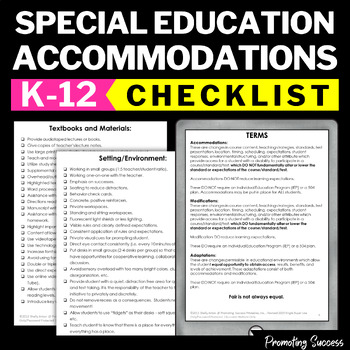
  For a checklist of 175+ accommodations, click the picture:

Special Education Teachers Pay Teachers Promoting-Success

For more information on including students with special needs:


To implement a plan of action:

Special Education Teachers Pay Teachers Promoting-Success

Autism Help Strategies - 105 Pages!

Here is what you will receive:
WHAT IS AUTISM? 4 
FACT SHEET FOR KIDS 14 
AUTISM RIBBON 16 
10 MOST EFFECTIVE STRATEGIES 17 
EFFECTIVE INSTRUCTION 20 
STRUCTURED TEACHING: STRATEGIES FOR SUPPORTING STUDENTS WITH AUTISM 25 
DEVELOPING EXPRESSIVE COMMUNICATION SKILLS FOR NON-VERBAL CHILDREN WITH AUTISM 39 
INCREASING EXPRESSIVE SKILLS FOR VERBAL CHILDREN WITH AUTISM 54 
CALMING ACTIVITIES 75 
INCLUDING CHILDREN WITH AUTISM IN INCLUSIVE PRESCHOOLS: STRATEGIES THAT WORK 78 
EFFECTIVE PROGRAMMING FOR YOUNG CHILDREN WITH AUTISM (AGES 3-5) 90 
RESPITE CARE FOR CHILDREN WITH AUTISM 102

Special Education Teachers Pay Teachers Promoting-Success


Click HERE to sign up for secret sales and free printables 
from our Teachers Pay Teachers Promoting-Success store.

--------------------------------------

Click HERE to view our Teachers Pay Teachers Promoting Success store.

Click HERE to SUBSCRIBE to our newsletter for SECRET SALES and FREE printables.

Click HERE to follow us on Instagram.

Click HERE to follow us on Pinterest.

respiratory system teacherspayteacher.com/store/promoting-success

Tuesday, 2 December 2014

It's Okay to Provide Math Accommodations!

Fair isn't always equal.  Here are five math accommodations for your students!

Math accommodations Teachers Pay Teachers Promoting-Success

Click HERE to sign up for secret sales and free printables 
from our Teachers Pay Teachers Promoting-Success store.

Click HERE to sign up for exclusive coupons and 
secret sales in our We Love Printable Art etsy shop.

---------------------------------------------------------
1.  Multiplication Chart - This is especially useful when you are checking students understanding of more difficult multiplication and division concepts.  Are you testing the students on the process or their knowledge of multiplication facts?


2.   Graph Paper - This works well for many students!  It is difficult to complete a problem when you are unable to line up the numbers.  Try it for all your students!


3.  Number Lines - Once again, this can be a very appropriate accommodation.  What is the standard or objective of the lesson?  If your goal is for students to understand the process, rather than counting, then a number line may be appropriate.


4.  Place Value Chart - Actually, many anchor charts are appropriate as accommodations and make a great way to scaffold instruction.  The goal may be to wean the chart. 


Carson-Dellosa Measure Man Bulletin Board Anchor Charts


5.  Chunking of Problems - I'm not talking about the math strategy of chunking numbers. Although, it is a good strategy.  I am talking about breaking down assignments, worksheets, etc. into smaller sections.  Math worksheets can appear extremely overwhelming for students.  Cut the worksheet apart and give them a couple problems at a time.  Place the pieces in a Ziploc bag with "TO DO" written on it.  Provide an empty bag with the word, "COMPLETED!"  You will be amazed at how motivating this can be for some students!

Keep in mind when you are making worksheets, how do they visually appear. Are they easy to follow?  Too busy?   Task cards are a great alternative to worksheets.  If students understand the concepts, do they really need to do a 50 problem worksheet?  Perhaps you can give a student five task cards to test the standard you are teaching. If the students completes the task cards with success, is there really a point to an entire packet of worksheets addressing the same standard?

Here are some FREE task cards for you to try!


You may find more FREE math resources HERE.

You may also like:


Note: This blog contains some affiliate links from Amazon.


---------------------------------------

Click HERE to view our Teachers Pay Teachers Promoting Success store.

Click HERE to SUBSCRIBE to our newsletter for SECRET SALES and FREE printables.

Click HERE to follow us on Instagram.

Click HERE to follow us on Pinterest.


Wednesday, 15 October 2014

Shadow a Student for a Day


Click HERE to sign up for secret sales and free printables 
from our Teachers Pay Teachers Promoting-Success store.

Click HERE to sign up for exclusive coupons and 
secret sales in our We Love Printable Art etsy shop.

---------------------------------------------------------


Have you ever shadowed a student for a day?  Could you walk a mile in their shoes?  Veteran teacher, Grant Wiggins, did it for a day.  He shares the daily schedule, what he did in each class, his takeaways, and what he would do if he could go back (he is retired) to do it all again.  It is an extremely powerful read.  I think it would be great to use at the beginning of every single school year - whether teachers have read it a million time or not.  Better yet, arrange to make it possible for teachers to shadow a student throughout the day.  Would the results be different for K-3, 4-5, junior high or high school?  Why? Should the results be different?


Could you walk a mile in your students' shoes?

Head on over to read this great article by Grant Wiggins.


Task cards are also a great way to create movement in the classroom.  
Click HERE to see 20 ways to use task cards in your classroom!


Check out these great products to create movement in your classroom!

Saturday, 13 September 2014

Top 10 Autism Teaching Strategies

Top 10 Autism Help Strategies

Top 10 Autism Help Strategies Teachers Pay Teachers Promoting-Success


Autism is increasing at an alarming rate. The Centers for Disease Control and Prevention stated that the prevalence had increased to 1 in every 88 as of March 2012. While the cause of autism is still unknown, there are specific strategies that have been identified as most effective. Here are the top five most effective strategies.

1) Visual Schedules
Research clearly shows the successful results of implementing visual schedules with children. These schedules allow daily routines to be predictable, with clear expectations. Fear of the unknown causes anxiety. Children with autism or other special needs have a difficult time communicating their feelings of anxiety. Frequently this anxiety is demonstrated in negative or inappropriate behavior. Care givers must keep in mind that all behavior is communication.

Establishing and following a visual schedule reduces unexpected events or situations and assists children in predicting and preparing for transitions. Schedules themselves must be predictable. They are best as visuals, even when the child is able to read. A written schedule may be implemented later with caution and careful progress monitoring. In addition, they should be kept in the same location at all times. There are several resources and software programs that assist with schedule creation and universal graphics.

Children must be taught how to read and interpret the visual schedule. A "check schedule" transition cue is used to communicate to the individual each time he or she is to transition to a new activity. Visual schedules are effective at school and at home.

2) Environmental Considerations
Visual and auditory stimulation in the classroom and home must be taken into consideration. The classroom should be organized and predictable. The scissors should always be found in the same location. Homework is turned in in the exact same way each day. This is important in the home as well. The child's personal belongings have designated "homes." For example, a backpack is always found on the same hook. A favorite toy or book is on the same place on a book shelf.

Auditory stimulation must be examined as well. Do the chairs make a screechy noise as students move around? Is there a slow hum to the lighting? Is the fluorescent lighting too bright? Will a lamp set a different, calming mood? These considerations will vary from child to child; however, all visual and auditory stimuli must be examined. Be sure to think outside the box. Would a blue room be more calming than a yellow room?

3) Visual Structure
The environment needs to be organized visually to help children identify and comprehend what is expected of them. Color coded folders for each content area may be coordinated with the visual schedule. Clearly defined areas, such as work stations, tape on the floor, and labeled centers provide structure. This may be done in the home as well. Some examples include:
· a designated spot at the dinner table
· a visual schedule for bedtime routine
· organized dresser drawers by color and items
· specific containers for each toy
· a daily schedule for weekdays and weekends

4) Alternatives to Verbal Communication
Some children may have significant impairments in expressive communication. Current technology may be very appropriate to increase appropriate behavior and independence. The Picture Exchange Communication System (PECS) has been very effective. This is a system developed in 1985 that allows children to initiate conversation. It is not expensive and doesn't require complex equipment.

Other options include voice output communication devices. This is a very exciting area with all the latest technology and apps being created. Some devices are quite large and more durable for children who may not understand how to handle something with care. Other devices are so small they may be hooked to a belt loop for easy use out in the community.

Augmentative communication is a great strategy. However, it is important to understand the universal means of communication and ensure the device or method may be implemented with any child or adult, not just school personnel or caregivers. A back up system of communication should be available in case of a device malfunction or misunderstanding on the recipient of the message, i.e. a grocery store worker, a new student, a substitute teacher.

5) Direct Instruction of Social Skills
Many children with special needs will benefit from direct instruction in social skills. Most do not learn interaction skills by simply being placed in social environments. Social skills must be taught in the same direct instructional way as any other academic content area.

Research has shown social stories and social scripts to be highly effective. Social stories target behaviors that need to be modified or reinforced in real life situations. Replacement behaviors must also be taught. Simply showing or telling the child what not to do is not effective. Social scripts are short scripts children learn and practice. For example, everyone uses a very similar social script when greeting a colleague in the morning. Some children must be taught these common scripts.

6) Literacy Instruction
Because many students with autism rely on some form of augmentative communication, even if it is only a backup, literacy instruction is very important. If a student is literate, s/he will be able to communicate at a much higher level than if the child is forced to depend on communications devices that are programmed with limited vocabulary. Literacy instruction should begin at a very early age and continue throughout all school years.

7) Sensory Opportunities

Most students with autism have some sensory needs. Many find deep pressure very relaxing. Others need frequent opportunities for movement. All students should have a sensory profile completed by an occupational therapist or other professional trained in sensory integration. Based on the profile, a sensory "diet" can be created and implemented throughout the day.

8) Consistency
All students do best when the daily program remains consistent with clear expectations. All staff working with students with autism need to be well-trained and must implement the daily program as consistently as possible.

9) Take advantage of student strengths and interests

Many students with autism have particular strengths and interests and these should be taken advantage of in the classroom. For example, if a student demonstrates an interest in trains, the student should have opportunities to read about trains, write about trains, do math problems about trains, etc.

10) Functional Curriculum

Students with autism have a great deal of potential to live and work independently as adults. The curriculum should place a strong emphasis on following a functional curriculum. Skills that emphasize daily living skills, community skills, recreation and leisure and employment need to be incorporated into the curriculum. Students in inclusive settings can follow the regular curriculum, but emphasis should be placed on those skills that are the most functional. Functional academics should always include literacy (reading and writing), basic math, time and money skills. Self-care skills, domestics, recreation and community experiences should also be emphasized. Older students should have formal employment opportunities beginning in middle school.
All children experience more success when daily expectations are consistent and clearly communicated.  Administrators, exploratory teachers, para-educators, and other staff must be properly trained and instructed in procedures to maintain structure and consistency.  In addition, parents, grandparents, daycare providers, etc., must follow the some routines with consistent behavioral expectations to reduce the child's anxiety.

Thursday, 28 August 2014

Top 10 Ways to Motivate Students to Learn Math

The beginning of the school year is time for fun, getting-to-know-you type activities.  I have several ideas posted HERE.  Students are always willing to share their favorite subjects, such as recess, P.E., art, etc. LOL  They are also willing to share their least favorite which is usually math - unfortunately!  It was actually always my favorite! Math is important!  A 2007 study published in the Journal of Development Psychology revealed that math skills at kindergarten is a stronger predictor of later school achievement than reading skills or the ability to pay attention. So how do we motivate students to learn math?

Math Teachers Pay Teachers Promoting-Success

"The different branches of Arithmetic -- Ambition, Distraction, Uglification, and Derision." --The Mock Turtle, from Alice in Wonderland, Lewis Caroll

Click HERE to sign up for secret sales and free printables 
from our Teachers Pay Teachers Promoting-Success store.

Click HERE to sign up for exclusive coupons and 
secret sales in our We Love Printable Art etsy shop.

---------------------------------------------------------

Here are my Top 10 Ways to Help Students LOVE Math!


1. MODEL the LOVE.  Students are smart and PERCEPTIVE.  They can sense, and many times voice, which content areas are their teacher's favorites. Show excitement in math - it is contagious!

2. Make it REAL!  When students see a purpose for learning, interest goes way up!  My students were always most motivated by using the Sunday advertisements (print or online).  We used addition, subtraction, multiplication, division, fractions, percents, units, ratios and more every week by shopping through ads.  In addition, encourage to share each week how math has impacted their daily lives!

3. SHOW it.  Use manipulatives (no matter what their age) and drawings to SHOW how math problems work!  SHOW what the division of fractions really is. SHOW how to determine the perimeter by walking around the school. SHOW, SHOW, SHOW!


4. Play GAMES. Research shows that movement in the classroom increases achievement.  Students CAN move and learn at the same time - many times BETTER.


5.  Build on their SCHEMA.  What experiences have the students had in the past?  What are their areas of interest?  Use these as examples in word problems. I once had a student with autism who loved Sponge Bob.  Appropriate or not, this was HIGH interest!  I actually watched some of the show each morning, so I could reference it to my student.  Once time on Sponge Bob, it was National Balloon Day, so I took him a balloon! LOL We did math problems about the cost of balloons, distribution (division) and probability of colors.  I have also been known to watch WWE (wrestling entertainment) just so I could reference it the next day.  How does this entertainment industry work.  How do the wrestlers in income? How much?  How about advertisers?  What are their costs? Etc.  Yes, if you get creative you can TIE anything to math.  Think about vacations, sports, art, music, etc.  They will all work!

6.  Provide parents with SUPPORT.  Many times the students are mimicking their parents' attitudes or fears about math.  Let's face it, some of the methods today are quite different than years ago.  Give the parents needed information.  Ensure that homework is for extra practice and not new learning.  Communicate with parents that homework is not their responsibility.  Help is always available for students the next day who are having trouble understanding.

7. ENGAGE. Let students engage in math...TEACH it.  

“Tell me and I forget, teach me and I may remember, involve me and I learn.” ~Benjamin Franklin


8.  Allow them to experience SUCCESS.  Restructure learning so that students have maximum opportunity for success.  As educators, we are always engaging in higher learning for license renewal.  Think how motivated you would be if you were constantly not understanding the content and receive poor marks.  How long would YOU continue?

9. Assess math ANXIETY.  Yes, this is real.  Mention the word "math" to some people, and monitor their heart rate.  The thought of math can bring upon real physiological reactions.  Teach students relaxation skills and help them feel prepared.  Scaffold lessons and utilize anchor charts.  


10. CELEBRATE.  Acknowledge achievements and milestones.  Everyone likes a pat on the back!


What is your favorite subject?  How will you instill of love of math in your students?

~Shelly